
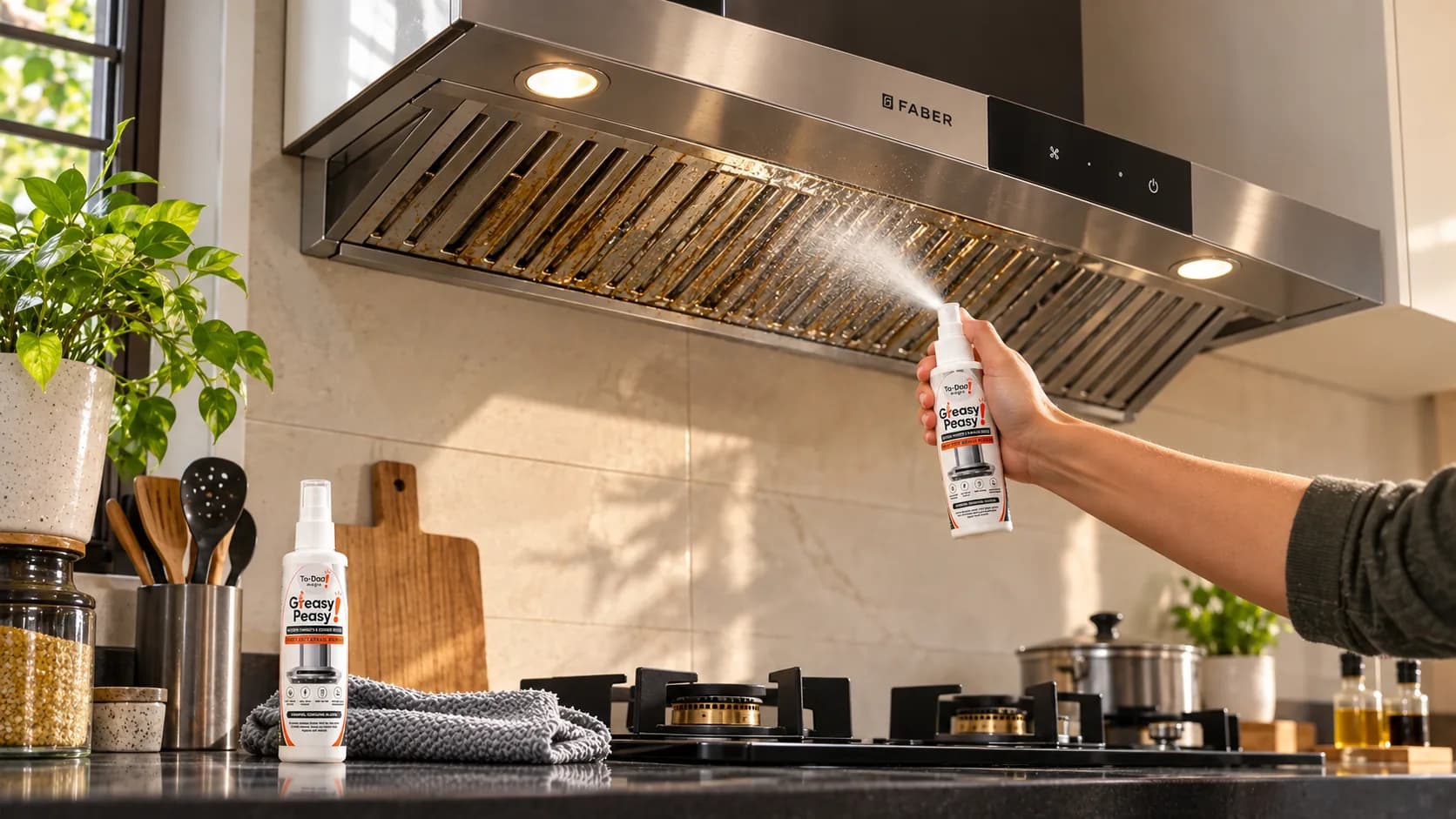
Kitchen chimneys take the worst of every meal — baked-on grease, carbon, and smoke residue that build up on the baffle and filter mesh long before you notice the suction weakening. Greasy Peasy's spray-wait-wipe formula is made for exactly this: hard kitchen surfaces caked in cooked-on grime, no scrubbing required.
The one thing every chimney has that a stovetop doesn't is a motor housing sitting right behind the baffle. Spray carelessly and you risk soaking electrical components instead of just the panel. This guide walks through doing it safely.
Before you start
Switch the chimney off at the wall, not just the fan speed dial. Let the panel cool if you've been cooking recently — Greasy Peasy works on cool, dry surfaces. Lay a towel underneath to catch drips.
Remove what you can
Unclip the baffle filter or mesh panel and take it out of the chimney housing wherever your model allows. Cleaning it away from the motor removes the soaking risk entirely, and it's easier to work on flat on a counter or in the sink.
Spray, wait, wipe
Spray Greasy Peasy directly onto the cooled, dry surface. Give it 2-3 minutes for everyday grease, or up to 5 minutes on heavier, baked-on carbon build-up. Wipe with a damp microfiber cloth, then rinse the panel clean with water before refitting.
If the panel can't be removed
Some chimney models have a fixed baffle. Spray a cloth with Greasy Peasy rather than the panel directly, and wipe rather than spray in place — this keeps the formula off the motor housing behind it while still lifting the grease.
Aftercare
Let the panel air-dry fully before refitting and switching the chimney back on. A light wipe-down every one to two weeks stops grease from baking on in the first place, so a deep clean like this is needed less often.